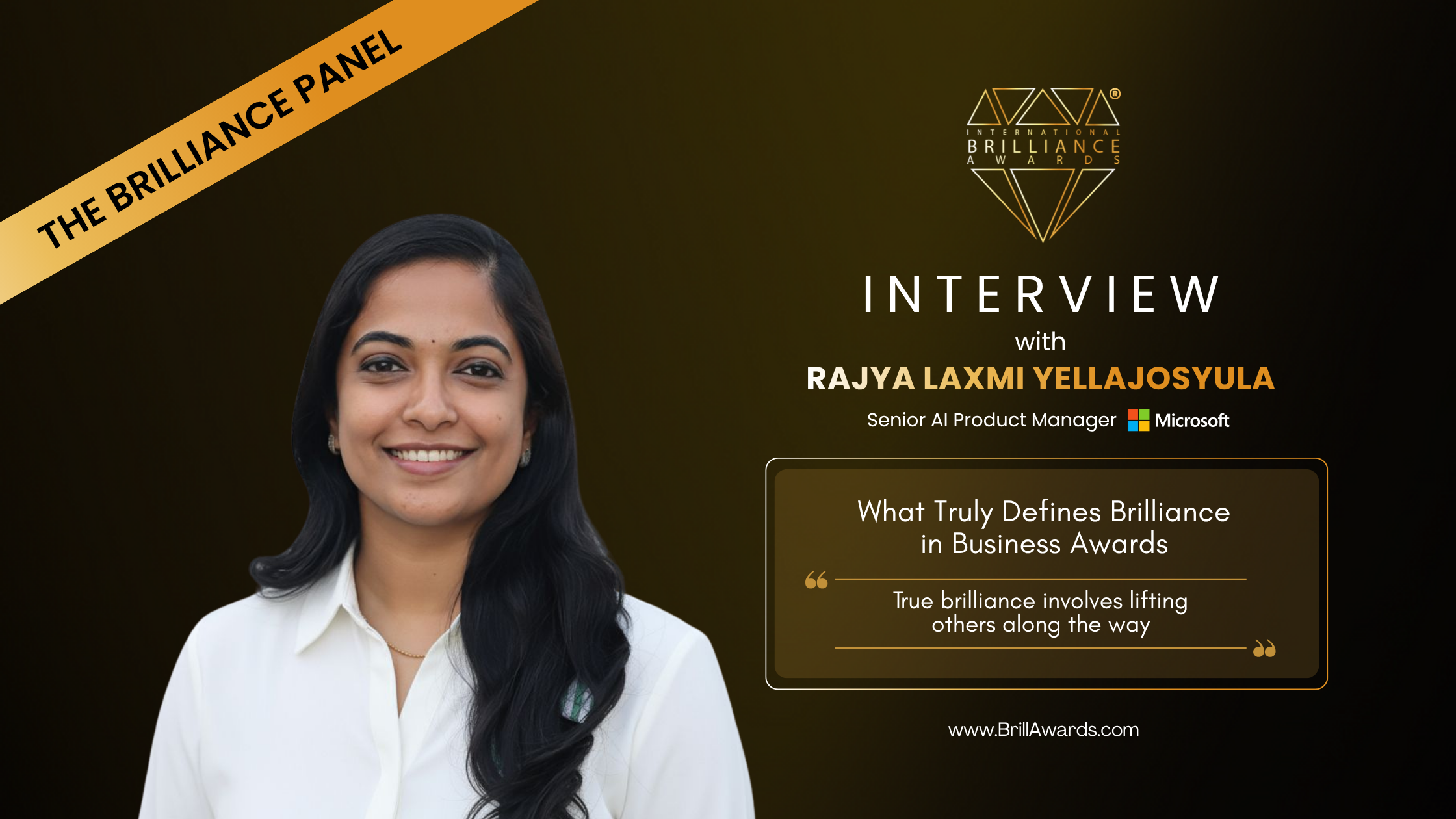
The Brilliance Panel: Insights from Rajya Laxmi Yellajosyula, Senior AI Product Manager, Microsoft
What Truly Defines Brilliance in Business Awards
The Brilliance Panel is a series from the International Brilliance Awards™ where we speak directly with our judges to understand the “why” behind award-winning work. In this edition, we sit down with Rajya Laxmi Yellajosyula, a Senior AI Product Manager at Microsoft. At the forefront of technological innovation, Rajya leads agentic AI strategy for enterprise cloud platforms, specialising in the design and implementation of sophisticated AI solutions that drive organisational transformation. Her expertise lies at the intersection of technical precision and strategic scale, ensuring that emerging technologies deliver tangible value in complex enterprise environments. As a judge, she brings a deep understanding of how “brilliance” is defined when cutting-edge AI meets real-world application. In this interview, she shares her perspective on the evolution of agentic systems, the importance of strategic AI integration, and the specific qualities she looks for in a winning submission.
You lead agentic AI strategy for enterprise cloud platforms. What has been the most rewarding part of deploying these complex systems at scale?
The most rewarding part has been seeing AI move beyond experimentation and become deeply embedded into real world enterprise operations. When you work on agentic AI systems at enterprise scale, you are not just deploying models, you are enabling organisations to fundamentally change how decisions are made, how workflows operate, and how people interact with technology.
What excites me most is helping enterprises operationalise AI in environments that are traditionally very complex, such as multi cloud systems, regulated industries, and mission critical infrastructure. Seeing AI move from a proof of concept into a trusted production system used daily by thousands of users is incredibly fulfilling because that is where real transformation happens.
What is the most common misconception businesses have about AI today?
One of the biggest misconceptions is that AI itself is the solution. In reality, AI is only one layer of a much larger ecosystem involving data quality, infrastructure, governance, security, observability, and operational readiness. Many organisations focus heavily on selecting the best AI model, but the real challenge is integrating AI into existing enterprise systems in a reliable and scalable way. Businesses often underestimate how important operational architecture and adoption strategy are in determining whether AI succeeds in production.
Many AI projects stay as experiments. What is the secret to successfully moving an AI project from a “test” to “real life” production?
The biggest difference between an AI demo and a production AI system is operational trust. Enterprises need confidence that AI systems are reliable, observable, secure, and aligned with business workflows. The organisations that succeed are the ones that treat AI as a platform capability rather than a standalone experiment. That means investing in governance, monitoring, integration patterns, human oversight, and scalable infrastructure from the beginning.Another equally important factor is focusing on business value first. The most successful AI deployments solve a very clear operational problem rather than trying to apply AI everywhere at once.
What do you see as the “next big thing” in AI for regular, non tech businesses?
I believe the next major wave will be agentic AI systems that can autonomously coordinate workflows across multiple enterprise applications and data systems. Today, many businesses still operate with fragmented systems and manual coordination. Agentic AI has the potential to act as an intelligent orchestration layer that can reason across tools, automate decisions, and proactively assist employees. For non technical businesses, this means AI becoming less of a “tool” and more of an operational collaborator embedded into day to day workflows just like another colleague on their team.
You are a strong advocate for women in STEM. How can we ensure the next generation of AI is more inclusive and accessible?
We need to make AI education, mentorship, and opportunities accessible much earlier, especially for young women and underrepresented communities. Representation matters because people are far more likely to pursue careers where they can see others who look like them succeeding and leading. It is equally important for women in STEM to speak more openly about their experiences, challenges, and achievements. Women often do incredible work but tend to shy away from talking about themselves and their accomplishments, which can sometimes make their contributions less visible. Even today, there are moments when I find myself as the only woman in a room discussing AI and enterprise technology, which highlights how much more progress is still needed.
It is also critical to create environments where diverse perspectives are actively included in the design and development of AI systems. AI technologies increasingly influence every aspect of society, so the teams building these systems should reflect the diversity of the people who use them.Ultimately, inclusivity in AI is not only about increasing participation. It is also about ensuring that AI systems are designed responsibly, ethically, and with a strong awareness of their broader societal impact.
As you prepare to review entries for the International Brilliance Awards™, what will you be looking for first?
I will first look for clarity of impact. Strong innovation is not only about technical sophistication, it is about whether the work creates meaningful value and solves a real world problem effectively. I am particularly interested in entries that demonstrate a strong balance between innovation, scalability, and practical implementation. I also value originality and the ability to think beyond incremental improvements.
What, in your view, will separate a strong entry from one that doesn’t quite stand out?
The strongest entries are usually the ones that clearly articulate both the problem and the measurable impact of the solution. Many submissions focus heavily on technology but spend less time explaining why the work matters or how it changes outcomes.
What makes an entry stand out is a combination of: clear vision, technical depth, real world applicability, evidence of execution and measurable results, and the ability to connect innovation to tangible human or business impact is what truly differentiates exceptional work.
What is one thing entrants often overlook when preparing their submissions?
Many entrants underestimate the importance of storytelling and context. Even highly technical innovations need a clear narrative explaining the challenge, the reasoning behind the solution, and the broader significance of the work.
Judges often review many technically strong submissions, so the entries that stand out are the ones that communicate their impact clearly and cohesively rather than assuming the technology speaks for itself.
What does “brilliance” mean to you?
To me, brilliance is the ability to turn complex ideas into meaningful impact for others. It is not just intelligence or technical skill, it is the combination of creativity, execution, resilience, and the willingness to solve difficult problems that genuinely improve people’s lives or experiences.
True brilliance also involves lifting others along the way, creating systems, opportunities, and innovations that enable broader progress beyond individual success.
About the International Brilliance Awards™
Founded in 2014, the International Brilliance Awards™ recognise work defined by clear thinking, strong execution, and meaningful business impact across organisations worldwide.
The International Brilliance Awards™ serve as the flagship programme of the Brilliance Awards family, which includes Business Brilliance Awards, HR Brilliance Awards, Internal Communications (IC) Brilliance Awards, Marketing & PR Brilliance Awards, Sales & Revenue Brilliance Awards, and Sustainability & ESG Brilliance Awards.
Each programme focuses on a distinct area of organisational performance, while maintaining a consistent standard of evaluation through an independent, blind judging process.