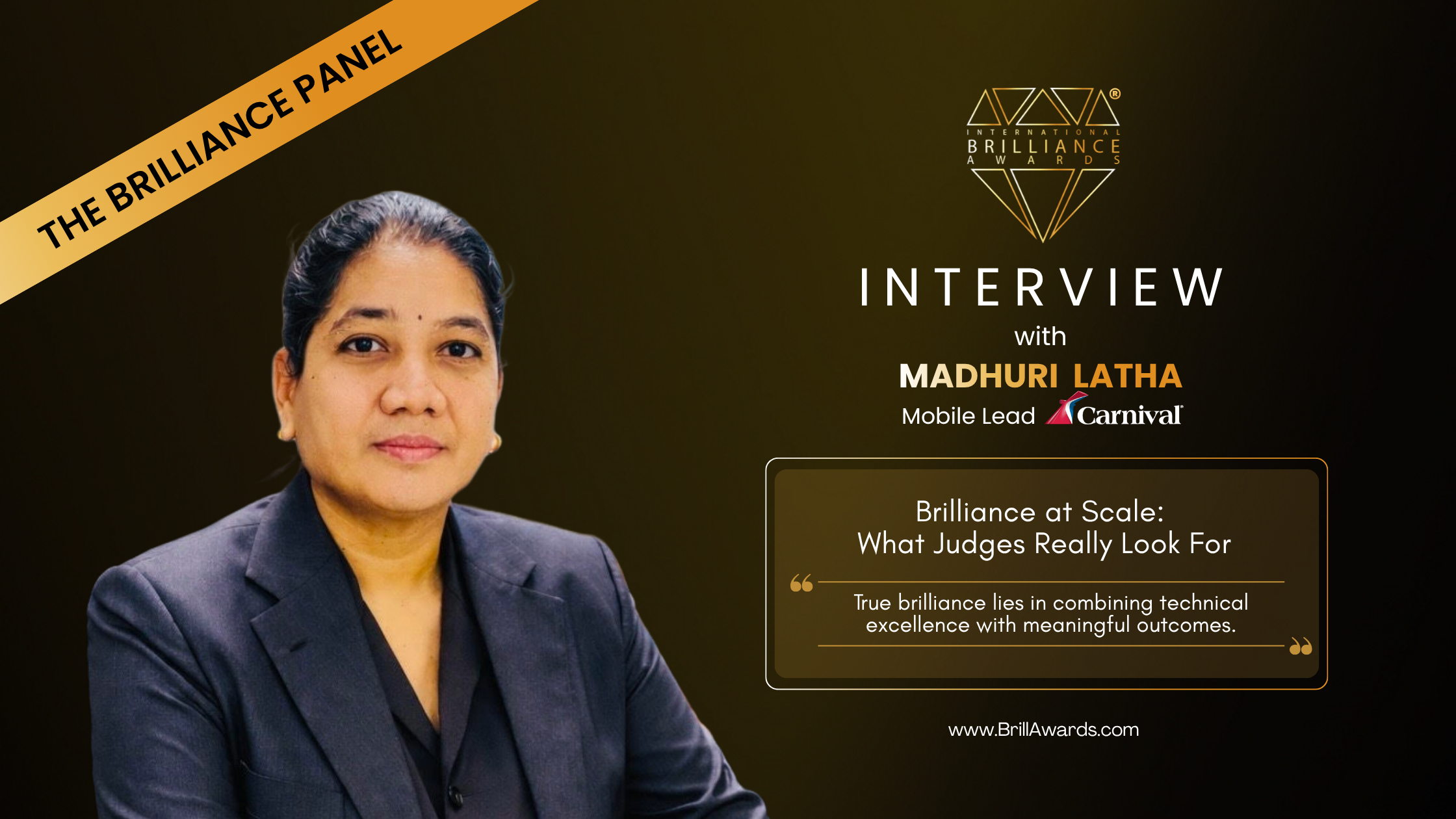
The Brilliance Panel: Insights from Madhuri Latha Gondi, iOS Technical Lead, Carnival Cruise
Brilliance at Scale: What Judges Really Look For
The Brilliance Panel is a new series from the International Brilliance Awards™, where we speak directly with our judges to understand what truly stands out.
In this edition of The Brilliance Panel, Madhuri Latha Gondi, an iOS Technical Lead at Carnival Cruise, shares her perspective, shaped by over a decade of experience building enterprise-scale mobile applications used by millions of users.
From designing high-performance, scalable platforms using modular architecture to enabling seamless collaboration across engineering, product, and design teams, Madhuri brings a system-driven and user-centric approach to technical leadership. In this interview, she shares what she will be looking for when reviewing entries, the common mistakes people make when presenting their success stories, and what truly defines strong, high-impact submissions.
You lead mobile development for high-performance applications. What is the biggest lesson you’ve learned about delivering tech at a massive scale?
In large-scale mobile platforms and distributed systems, the biggest lesson I’ve learned is that success depends on how well engineering integrates with cross-functional teams.
At scale, applications are not standalone systems. They depend heavily on backend services, product strategy, design systems, and analytics. The key is building an architecture that allows teams to move independently while still aligning with evolving system contracts and product direction.
In my experience, scalable delivery comes from strong system design, clear interfaces, and continuous collaboration across teams. Ultimately, delivering at scale means creating an environment where multiple teams can innovate simultaneously without compromising the user experience.
In such a competitive space, what is the most important thing to get right when building a high-performance mobile app?
The most critical factor is ensuring a consistent user experience across real-world conditions and system dependencies.
Performance is about how well an application handles asynchronous data, integrates with backend services, and maintains stability across environments. This requires close collaboration between engineering, product, and quality teams.
The goal is to build systems where variability, whether from networks, services, or scale, does not negatively impact the user experience. That level of resilience comes from strong cross-team alignment and well-defined system boundaries.
You mentor many engineering teams. What is the best piece of advice you give to young engineers just starting their careers?
I advise engineers to look beyond their immediate area of work and understand the entire system they are building within.
Great engineers develop a deeper understanding of system design, product requirements, user behavior, and the trade-offs between performance, scalability, and maintainability.
I also emphasise the importance of communication and collaboration. The ability to work effectively across teams is just as important as technical expertise. Engineers who grow quickly take ownership beyond their tasks, ask the right questions, and think in terms of overall system impact.
Modular design is a speciality of yours. How does this approach change the way a company builds for its future?
In large-scale application development, modular architecture enables teams to scale both technically and organizationally.
Instead of monolithic systems, modular design allows independent feature development, clear ownership boundaries, and faster iteration without introducing risk to unrelated areas.
From a cross-functional perspective, it enables teams to work in parallel while reducing dependencies and improving maintainability. It also simplifies collaboration by creating well-defined interfaces between components.
Ultimately, modularity transforms organisations into platform-driven ecosystems, enabling faster innovation and long-term sustainability.
Mobile is always changing. What is one trend that will fundamentally change our daily lives in the next two years?
One of the most transformative trends is the rise of AI-powered, context-aware experiences across modern applications.
As on-device intelligence and cloud capabilities continue to evolve, applications are shifting from reactive tools to proactive systems that anticipate user needs. This will require closer collaboration across product, engineering, and data teams to deliver personalised, real-time experiences.
In the coming years, users will expect applications to reduce friction, adapt dynamically, and provide meaningful insights with minimal input. This convergence of AI and user-centric design will fundamentally reshape how we interact with technology.
As you prepare to review entries for the International Brilliance Awards™, what will you be looking for first?
The first thing I look for is a clear, measurable impact. Strong entries demonstrate how teams collaborated across functions, addressed real-world challenges, and delivered meaningful outcomes.
I also evaluate the quality of execution, integration within broader systems, and the ability to scale. The most compelling entries show true end-to-end ownership, from idea to execution to tangible results.
What separates a good entry from a winning one?
A good entry explains what was built. A winning entry demonstrates why it matters at scale.
Winning submissions clearly show how teams collaborated, how decisions improved performance or scalability, and what measurable impact was achieved. They also reflect thoughtful decision-making and trade-offs, which indicate true engineering maturity.
In your experience, what is the most common mistake people make when presenting their success stories?
The most common mistake is presenting work in isolation, focusing heavily on the solution while overlooking the broader context in which it was developed.
Strong success stories clearly explain the problem, the complexity involved, and how teams collaborated to solve it. Another frequent gap is the lack of measurable outcomes. Without clear metrics, such as performance improvements, user impact, or business value, it becomes difficult to evaluate the true significance of the work.
The most effective narratives connect the full journey: problem, cross-functional collaboration, execution, and tangible results.
What does “brilliance” mean to you in today’s business environment?
In today’s business environment, brilliance is defined by the ability to translate complex ideas into scalable, real-world impact.
True brilliance lies in building solutions that combine technical excellence with strong cross-functional collaboration to deliver meaningful outcomes at scale.
Brilliance is evident when a solution solves a clearly defined problem, scales reliably, and delivers measurable improvements in performance, experience, or business value.
As a judge for the International Brilliance Awards, I view brilliance as the intersection of innovation, execution, and impact. The most outstanding work demonstrates clarity of purpose, strong collaboration, and the ability to create lasting value.
About the International Brilliance Awards™
Founded in 2014, the International Brilliance Awards™ recognise work defined by clear thinking, strong execution, and meaningful business impact across organisations worldwide.
The International Brilliance Awards™ serve as the flagship programme of the Brilliance Awards family, which includes Business Brilliance Awards, HR Brilliance Awards, Internal Communications (IC) Brilliance Awards, Marketing & PR Brilliance Awards, Sales & Revenue Brilliance Awards, and Sustainability & ESG Brilliance Awards.
Each programme focuses on a distinct area of organisational performance, while maintaining a consistent standard of evaluation through an independent, blind judging process.