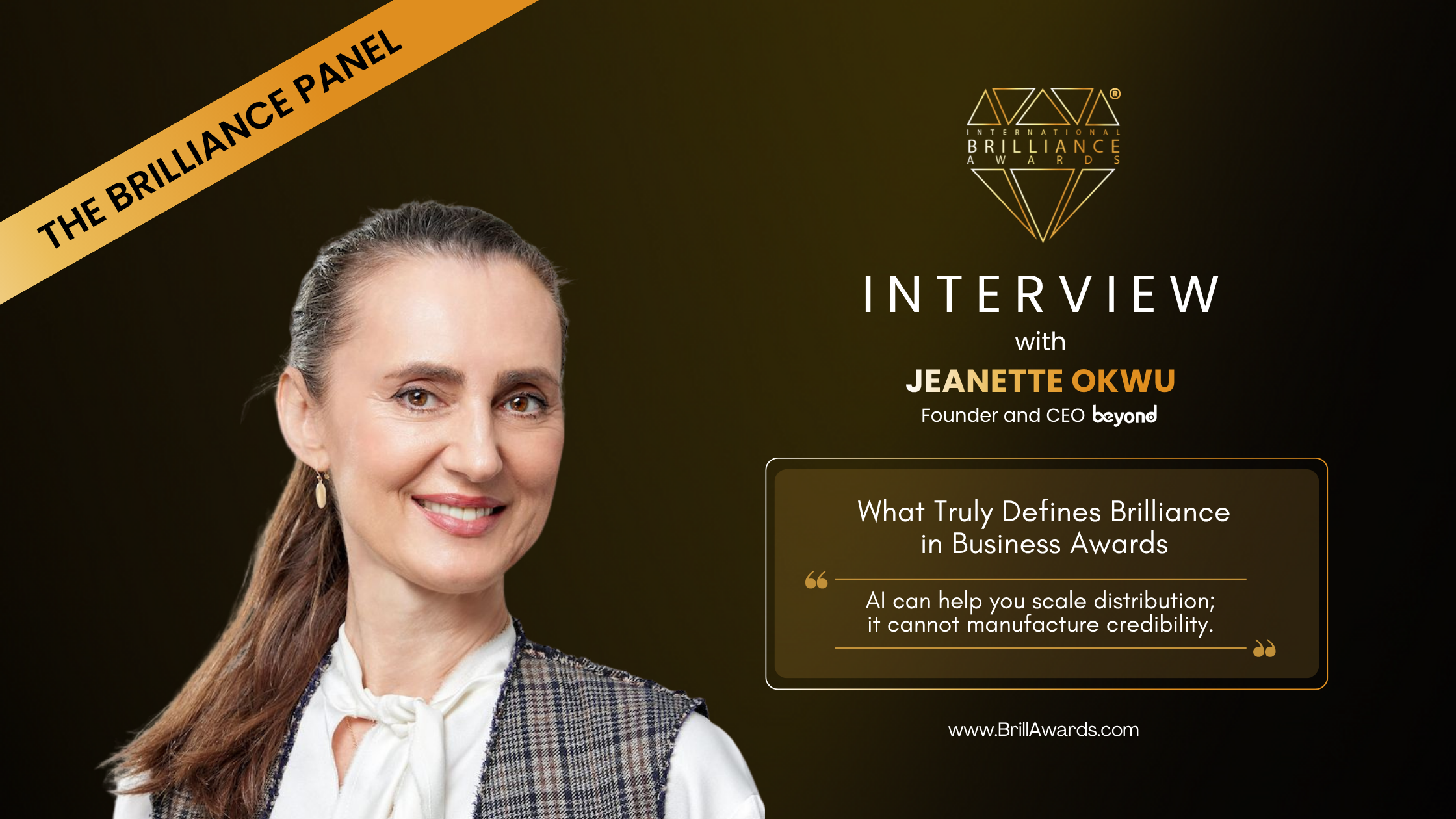
The Brilliance Panel: Insights from Jeanette Okwu, Founder and CEO, beyondINFLUENCE
What Truly Defines Brilliance in Business Awards
The Brilliance Panel is a series from the International Brilliance Awards™ where we speak directly with our judges to understand the “why” behind award-winning work. In this edition, we sit down with Jeanette Okwu, the Founder and CEO of beyondINFLUENCE, whose background in journalism informs her sharp editorial perspective on brand strategy. With over two decades of experience spanning the United States and China, Jeanette understands that true digital success stems from “cultural fluency” rather than mere market presence.
As the host of the Influence By Design podcast and Co-Chair of the European Influencer Marketing Alliance (EIMA), Jeanette provides a masterclass on staying ahead of the curve by looking toward regulatory trends and primary field intelligence. In this interview, she shares why editorial judgment is the antidote to failing digital strategies, how AI is paradoxically making human influence more valuable, and why she prioritises “evidence of intent” when opening an award submission.
With a background in journalism and now leading a marketing agency, how has your editorial perspective influenced your digital strategies?
Journalism trained me to listen before I speak, to interrogate the incentive behind the narrative, and to be deeply skeptical of anything that sounds too clean. Those instincts never left.
When I approach a brand campaign, I think like an editor: what is this actually saying, to whom, and why would anyone believe it? Most digital strategies fail not because of bad media buying but because of bad editorial judgment. Brands launch campaigns when they should be thinking about what it means to earn a reader’s attention first. That shift in perspective changes everything, from creator selection to content architecture to how you define success.
You’ve worked extensively in the US, China, and Europe. What is the biggest lesson global brands can learn from the fast-changing digital landscape in China?
China taught me what “platform dependency” really means when it’s not theoretical. Ecosystems there evolve overnight. What works on Monday is irrelevant by Friday. Brands that survived that environment weren’t the ones with the biggest budgets; they were the ones who built genuine local intelligence and could pivot at speed without losing brand integrity.
The lesson for global brands is simple: don’t confuse market presence with market understanding. A regional office and a local creator roster are not the same as cultural fluency. China made that distinction very expensive for brands that ignored it.
How do you see AI fundamentally changing influencer marketing by 2027?
AI is already commoditizing content production. That means the volume of branded content is going up while its average quality is getting noisier. By 2027, audiences will be even better at filtering out what doesn’t feel human. The paradox AI creates is that genuine human influence becomes more scarce and therefore more valuable, precisely because AI makes everything else look the same.
For brands, the shift needs to be strategic: stop optimizing for quantity of content and start building systems that identify and protect the creators who carry real trust. AI can help you scale distribution; it cannot manufacture credibility.
Digital trends move faster than ever. What is your secret for staying ahead of the curve?
I talk to people who are inside the machine. Platforms, creators, regulators, and brand strategists across different markets. Secondhand analysis of trends gets recycled very quickly. Primary intelligence from people who are actually operating in the field is where the real signal lives.
Beyond that, I read regulatory documents and legislative proposals. Most marketers find that boring. I find it predictive. Wherever regulators are paying attention, that’s where the industry is heading next, whether it’s prepared or not.
With the rise of automated content, do you believe influencer marketing is still effective today?
More effective than ever, for the right reasons. When everything around a consumer is generated, filtered, and optimized by an algorithm, a credible human voice becomes a rare asset. The question is no longer whether influencer marketing works but rather whether brands are managing it with enough rigor to make the investment defensible.
Too many brands still treat creators like a media buy. The winners are treating them like business partners, with audiences that have genuine skin in the recommendations.
As you prepare to review entries for the International Brilliance Awards, what will you be looking for first?
Evidence of intent. Anyone can report a good number after a successful campaign. What I want to see is whether there was a strategic reason behind the decisions made, or whether the result happened in spite of the approach rather than because of it. Awards that reward outcomes without interrogating process are just celebrating luck.
What is the first thing you look for when you open a submission?
Clarity of objective. If I can’t tell within the first two paragraphs what this campaign was actually trying to achieve, and for whom, I already know the strategic thinking wasn’t there. Great work starts with a specific, honest problem to solve. Vague objectives produce vague submissions and usually, vague results.
In your experience, what is the most common mistake people make when presenting their success stories?
They lead with the result and bury the context. A 40% engagement lift sounds great until you find out the benchmark was set against a campaign that ran during a crisis, for example. Success stories need to be honest about the starting conditions, the constraints, and the decisions made under pressure. That’s what makes a case study credible rather than just impressive-looking.
What does “brilliance” mean to you?
A solution that makes you ask why no one did it that way before. Brilliance in marketing isn’t complexity. It tends to look obvious in hindsight, which is exactly what makes it so difficult to produce in the first place. You need enough judgment to simplify, and enough courage to commit to the simple answer when everyone around you is overcomplicating it.
About the International Brilliance Awards™
Founded in 2014, the International Brilliance Awards™ recognise work defined by clear thinking, strong execution, and meaningful business impact across organisations worldwide.
The International Brilliance Awards™ serve as the flagship programme of the Brilliance Awards family, which includes Business Brilliance Awards, HR Brilliance Awards, Internal Communications (IC) Brilliance Awards, Marketing & PR Brilliance Awards, Sales & Revenue Brilliance Awards, and Sustainability & ESG Brilliance Awards.
Each programme focuses on a distinct area of organisational performance, while maintaining a consistent standard of evaluation through an independent, blind judging process.