The Brilliance Panel: Insights from Anna Lawlor, Director, Head of Digital & Social Media, GT | Greentarget UK
What Truly Defines Brilliance in Business Awards
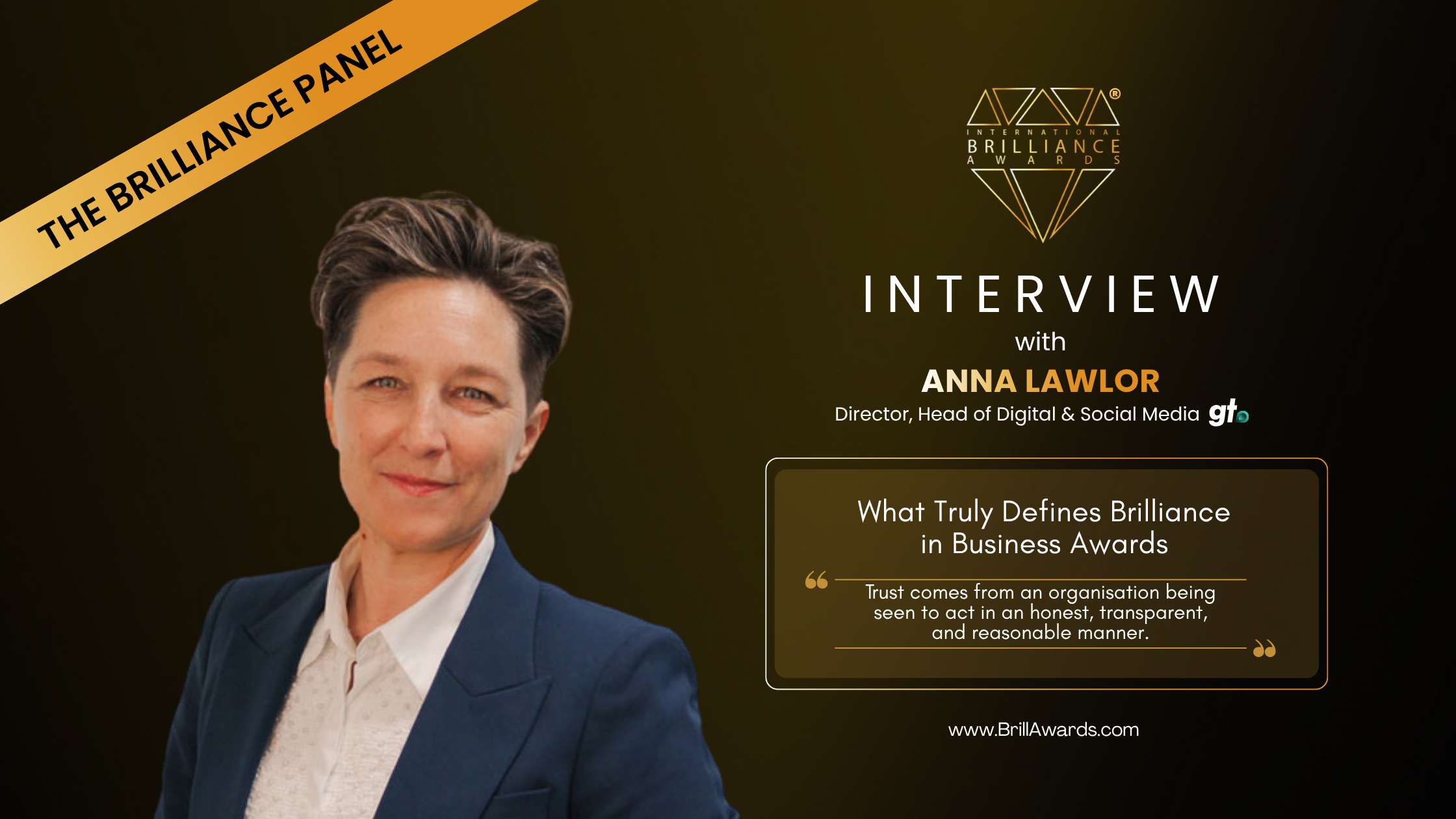
The Brilliance Panel is a new series from the International Brilliance Awards™, where we speak directly with our judges to understand what truly stands out. In this edition of The Brilliance Panel, Anna Lawlor, Director and Head of Digital & Social Media at Greentarget, offers her expert perspective on managing communication at the intersection of digital strategy and reputation risk. With specialised experience working alongside complex, regulated businesses—Anna understands the unique challenges of maintaining brand integrity in a rapidly evolving digital landscape. From addressing the rise of AI-driven threats like deep fakes and disinformation to the importance of “platform-native” language, she provides a roadmap for how even the most conservative organisations can be brave online. In this interview, she discusses the non-negotiable need for crisis-readiness, how to leverage social listening for more human connections, and what she looks for in an award-winning entry.
How do you protect a brand during a digital crisis without losing audience trust?
I believe that it is how an organisation responds to a brand or reputational crisis that determines whether it loses or in fact enhances trust with the people that matter. Standard PR crisis protocols still apply here – acting quickly, communicating with empathy and action-orientated – but a social or digital crisis escalates more quickly. This is where pre-authorised crisis-ready social media content can be useful.
We need to move away from a single external statement being shared with traditional media; people expect clarity, reassurance and credibility in a message on any platform the organisation is usually found. That means speaking the language of the chosen platform, such as social media, to convey the same crisis messaging. Having pre-established protocols and a crisis manual that includes an array of social and digital potential harms is non-negotiable.
The trust element comes from an organisation being seen to act in an honest, transparent, and reasonable manner. Nothing undermines trust quicker than an organisation on the back foot offering subterfuge from a defensive position, and lost trust and credibility is much harder to win back in the post-crisis environment.
What is the biggest digital risk that organisations are currently ignoring?
Phew! The pace of digital change and the evolving threat landscape means there’s a lot to consider and plenty of fear and overwhelm to match. I will say, though, there are things every organisation can do for improved digital crisis preparedness, that it becomes less scary when you have a solid, stress-tested plan and the right expertise to call on.
Risks not being considered enough include social media crises stemming from orchestrated misinformation or disinformation; reputation threats from AI deep fakes of corporate leaders; and serious data leaks from employee AI use.
AI tools have lowered the barrier to entry for a range of potential digital harms, and social media provides a network to mass communications at scale and velocity against a backdrop of corroded media trust, with news increasingly blending with influencer opinion. An element of digital risk we’re not considering enough is how prolific the threat instigators are, from disgruntled employees to state-sponsored bad actors, from consumer niche online communities to cybercriminals – or a teen in their bedroom working out whether their agentic AI prompts can bring down a listed company for LOLs.
Regulated firms (like banks) can be cautious. How can a “serious” company be brave online without damaging its reputation?
At Greentarget, we specialise in working with regulated, complex businesses including those in financial services. Attention online is lost or won in milliseconds; no-one will stop scrolling for dry, boring jargon-heavy ‘corporatese’. So, a ‘serious’ company still has to entertain, inform and bring content value to its stakeholders.
For conservative, regulated companies, bravery is often stepping out of the shadow of their peer group. This is what has allowed challenger brands in conservative sectors to steal a march on established incumbents when it comes to translating corporate positioning into digital platform content.
Those who do it well, whether B2B or B2C regulated brands, they speak a platform-native language that resonates with their specific audience; tend to use educational framing rather than direct product-sell; know the importance of people-facing content not just data-visualisations; and they ideally have compliant guardrails to ensure fast-turnaround workflows.
You combine data with editorial expertise. How do you use data to make smarter, more human communication choices?
One example of this is how social listening can be deployed tactically. Social listening tools allow us to digitally ‘eavesdrop’ on public online conversations about topics, brands or people. Most brands use this for monitoring online reaction to a campaign or other brand sentiment reporting. An overlooked tactic is to dig into the conversations people are naturally having about a client’s corporate brand or service, segment the data by sentiment and use these insights to create key messages or other external corporate communications using this same natural language, knowing that it will likely resonate more strongly with the audience than ‘corporate’ language might. Just because a brand operates in a corporate, regulated environment, doing a complicated job means it’s all the more important to use clear, plain language – that’s what humans respond emotionally to and contributes to trust.
Why is independent and blind judging important in awards?
I love being an awards judge because I have now been on both sides of the awards table; I know the time, effort and hope poured into entering industry awards. I know the seismic efforts that go on behind the scenes to deliver great brand, marketing or PR work for clients. Independent, blind judging means every single entry gets the same fair, balanced assessment without preconceptions or conscious biases.
Of course, that does mean the onus is on the entry itself to tell us the specific context of the campaign or entry – so be sure to do that, show your thinking, be honest about what worked and didn’t, and tell us how it moved the needle.
About the International Brilliance Awards™
Founded in 2014, the International Brilliance Awards™ recognise work defined by clear thinking, strong execution, and meaningful business impact across organisations worldwide.
The International Brilliance Awards™ serve as the flagship programme of the Brilliance Awards family, which includes Business Brilliance Awards, HR Brilliance Awards, Internal Communications (IC) Brilliance Awards, Marketing & PR Brilliance Awards, Sales & Revenue Brilliance Awards, and Sustainability & ESG Brilliance Awards.
Each programme focuses on a distinct area of organisational performance, while maintaining a consistent standard of evaluation through an independent, blind judging process.