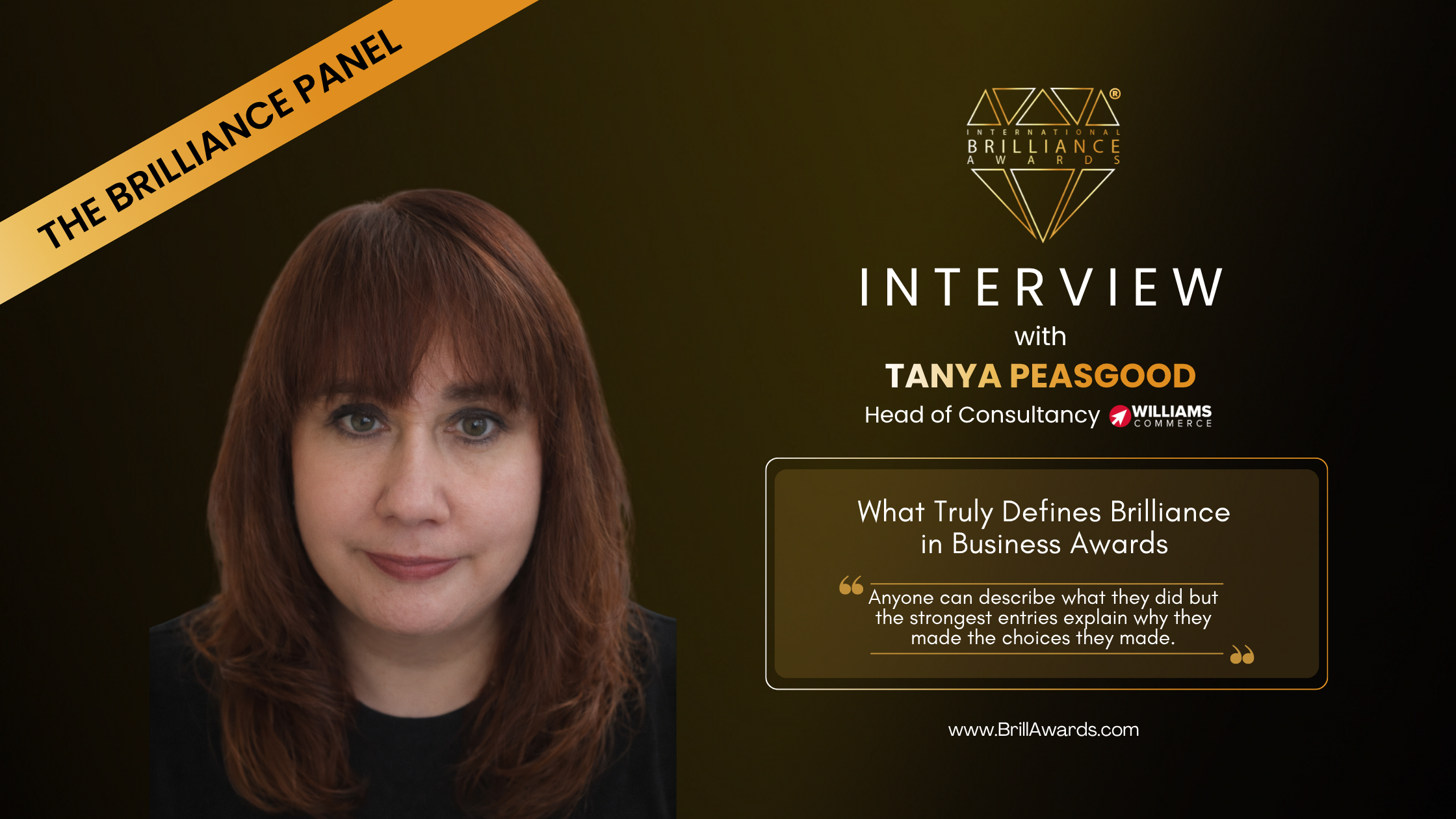
The Brilliance Panel: Insights from Tanya Peasgood, Head of Consultancy, Williams Commerce
What Truly Defines Brilliance in Business Awards
The Brilliance Panel is a new series from the International Brilliance Awards™, where we speak directly with our judges to understand what truly stands out.
In this edition of The Brilliance Panel, Tanya Peasgood, digital commerce consultant and Head of Consultancy at Williams Commerce, shares her perspective. Tanya leads teams in helping organisations define business requirements, shape strategic roadmaps, and deliver transformational e-commerce solutions.
With extensive experience in digital strategy and client delivery, she works closely with businesses to improve performance, customer experience, and long-term growth. In this interview, Tanya shares what she will be looking for when reviewing entries, the common mistakes organisations make when presenting their work, and what truly defines “brilliance” in a complex, real-world environment.
As Head of Consultancy, you lead teams in shaping strategic roadmaps. What is the most common challenge businesses face when trying to define their digital requirements?
Often, businesses look at what the competition is doing and try to copy that. If you don’t ground what you are doing in your own business model – identifying your goals, objectives, and how to measure success – you can be chasing something that looks ‘shiny’ but won’t help your business. It helps to take a step back and focus on your business needs first – what are your targets for the year, what can help you achieve them, and what are your blockers? Do that, and it gives you the foundation to drive forward
You specialise in delivering transformational e-commerce solutions. How do you balance complex technical needs with the need for a seamless, simple customer experience?
I’m quite lucky in that my background includes web design, and supporting e-commerce sites as a product owner when I used to work ‘client side’. It means that for any programme I work on, my automatic foundation is the customer experience. I treat discovery as a journey – how does the customer find you, how do they discover products, how do they buy them, what happens after they order. Taking businesses on this journey naturally identifies integration touchpoints and business processes, which we can then drill into with further reviews. I’m an advocate for simplicity, so I always aim to help businesses unpick that complex technical need into something that does the job in the most effective way possible – and a conversation with the right stakeholders gets you there.
Digital transformation is a major focus in your work. In your experience, what is the secret to moving from a high-level strategy to an effective, real-world execution?
It’s all about being pragmatic for me. You can have the most amazing strategy and ambitions, but if it’s going to take a 12-month project to deliver, it’s likely to be ineffective. I work with clients to identify what part of that ambition delivers the most value, and then we can focus on doing that first. It’s the ‘how do you eat an elephant’ analogy – take it one bite at a time, and you’ll get there. But underlying that is that you do have to know the full strategy firs,t so you can make sure everything you do is a step closer to meeting it.
What is the most important metric a brand should track to measure the success of its digital innovation?
Digital innovation only matters if it drives measurable change in customer behaviour that translates into commercial impact. The most important metric is the incremental uplift you can attribute directly to the innovation, whether that’s conversion rate, revenue per user, or customer lifetime value. If it’s not moving those levers, it’s not truly delivering value.
With the rapid evolution of digital commerce, what is one major trend you believe will fundamentally reshape how businesses interact with customers in the next two years?
Obviously, AI tooling is rapidly changing the way people discover products and transact online. I’m an advocate of agentic commerce, but I’m not assuming people will be completing full shop transactions in ChatGPT, Claude or Gemini. I think we will see increasing use of conversational commerce on sites as people become used to working with AI agents. We’re already seeing the way people search change – it’s not just ‘sofa’ anymore, it’s ‘3-seat small grey sofa’. I’m expecting the next step to be ‘I need a small sofa for my flat that fits with my hygge style furniture’ and then a more interactive process to filtering being ‘no, not like that, more rounded’ rather than box ticking.
As you prepare to review entries for the International Brilliance Awards™, what will you be looking for first?
I’m interested in clarity of thinking. Before anything else, I want to understand what the entrant was trying to achieve and whether they achieved it. The best entries make that connection immediately; it’s clear what the challenge was, how they approached it, and the outcome. I’m also looking for evidence of genuine strategic thinking rather than just what was delivered. Anyone can describe what they did, but the strongest entries explain why they made the choices they made.
What, in your view, will separate a strong entry from one that doesn’t quite stand out?
Vague claims about transformation or innovation tell me nothing. What I want to see is real detail, so actual numbers, honest context, and a clear sense of the obstacles that had to be overcome. Strong entries feel like they were written by someone who really lived the journey; they’re confident enough to talk about the complexity and not just the polish. Entries that don’t stand out tend to read like marketing copy with lots of claims and not much proof
What is one thing entrants often overlook when preparing their submissions?
Centre the human in the story. A lot of entries focus entirely on the technical or commercial outcome and forget to talk about the people involved. Tell me about the team that delivered it, the client stakeholders who had to be brought along, and the moments where things had to change course. Awards recognise work, but work is done by people, and the entries that stay with you are the ones where you can feel the effort and collaboration behind the result.
What does “brilliance” mean to you?
It’s not about the flashiest solution or the biggest budget. I think it’s about doing something well in the circumstances you were actually in. It’s what you did when the problem was messy. Did the decision you made with incomplete information turn out to be right, or did the team deliver something no one was quite sure was possible? Brilliance doesn’t have to shout about itself. You recognise it because it makes you think: that was the right thing to do, and they did it.
About the International Brilliance Awards™
Founded in 2014, the International Brilliance Awards™ recognise work defined by clear thinking, strong execution, and meaningful business impact across organisations worldwide.
The International Brilliance Awards™ serve as the flagship programme of the Brilliance Awards family, which includes Business Brilliance Awards, HR Brilliance Awards, Internal Communications (IC) Brilliance Awards, Marketing & PR Brilliance Awards, Sales & Revenue Brilliance Awards, and Sustainability & ESG Brilliance Awards.
Each programme focuses on a distinct area of organisational performance, while maintaining a consistent standard of evaluation through an independent, blind judging process.