The 13-Year Test: Why a Documented History is the Only Real Award of Credibility
Why a Documented History is the Only Thing That Proves an Awards Programme is Legitimate
Any organisation can launch an awards programme.
A website. A logo. A list of categories. An entry platform. A set of judging criteria that sounds rigorous without necessarily being so. None of these things are difficult to produce. None of them cost very much. And none of them – on their own – tell you anything meaningful about whether the programme behind them is worth your time, your money, or your professional reputation.
What tells you that is history.
Not claimed history. Not implied history. Not vague references to years of experience or a heritage of celebrating excellence. Documented, verifiable, independently traceable history, the kind that exists in public records, published winners lists, press coverage, ceremony photographs, and a digital footprint that goes back further than anyone would bother to fake.
That kind of history cannot be manufactured. It can only be built. And building it takes time; years of consistent delivery, honest judging, and genuine commitment to the organisations and individuals who trust you with their work.
This is what we think of as the 13-year test. Not because 13 is a magic number. But because 13 years of uninterrupted, verifiable, independently traceable history is not something that happens by accident. It is evidence of something real.
Why History Matters More Than Prestige
The awards industry has a prestige problem.
Prestige is easy to perform. Impressive language. Elegant design. Photographs of trophy ceremonies that may or may not have happened. Claims of international reach that may or may not be supported by actual international participants. Judging panels that may or may not consist of real, verifiable professionals.
Prestige, in other words, can be faked. History cannot.
When an organisation has genuinely been running a recognition programme for over a decade, the evidence accumulates in ways that are impossible to fabricate convincingly. Winners from seven years ago who still mention their recognition in their LinkedIn profiles. Press coverage from the early years that predates any strategic decision to manufacture credibility. Ceremony photographs featuring real people at real venues, people who can be found, contacted, and asked about their experience.
This accumulation of evidence is not glamorous. It does not make for impressive marketing copy. But it is the only reliable indicator of whether an awards programme will still mean something in five years and whether the recognition it offers today carries the weight it claims to.
What a Documented History Actually Looks Like
A programme with a genuine, documented history leaves traces that any organisation can find and verify independently.
Published winners lists going back multiple years, not just the most recent cycle, historical records that name specific organisations and individuals, in specific categories, from specific years. These lists should be publicly accessible and consistent with the timeline the programme claims. The International Brilliance Awards have published winners’ lists going back to 2014, all publicly available at brillawards.com/results/winners.
Verifiable press coverage. Genuine programmes generate genuine press coverage over time. Not just press releases republished on their own website, but also independent coverage in industry publications, trade press, and business media that predates any recent decision to invest in visibility. That coverage exists because journalists found the programme worth covering, which is a form of independent validation that cannot be bought retrospectively.
Explore Brilliance in Press™, where we showcase selected press coverage, media features, and independent mentions relating to the Brilliance Awards™.
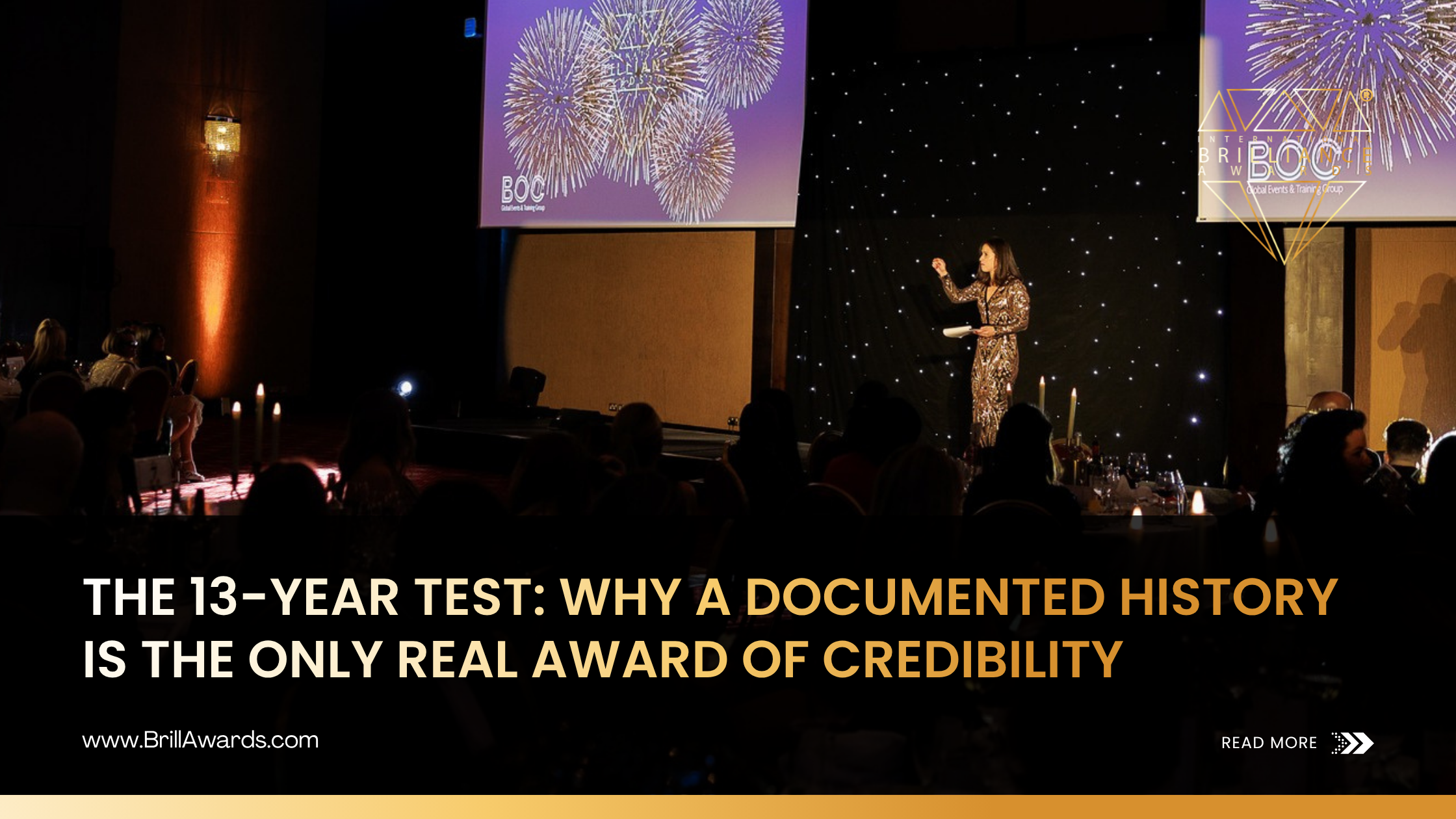
Real ceremony photographs. Every legitimate awards programme that holds an annual ceremony leaves a photographic record of that ceremony. Real photographs, taken by real photographers, at real venues, featuring real people who can be identified and contacted, accumulate over the years into an archive that tells the story of a programme’s growth and consistency.
These photographs are very different from stock imagery, AI-generated visuals, or carefully staged promotional shots. They have the imperfection of reality. Candid moments. Genuine reactions. The specific details of real venues, branded staging, recognisable interiors, and the particular quality of event lighting — that cannot be convincingly replicated.
View Brilliance in Pictures™, featuring ceremony photographs and documented moments from more than a decade of the Brilliance Awards™ history, from 2014 to the present day.
A traceable digital footprint. The internet has a long memory. Tools like the Wayback Machine at web.archive.org preserve historical versions of websites, allowing anyone to see what a programme’s online presence looked like at any point in its history. A programme that claims to have been running since a particular year should have a digital footprint that supports that claim, and one that predates any recent investment in looking more established than it is.
A verifiable organising company. Behind every legitimate awards programme is a legitimate organisation. One that is registered with the relevant business authority, has a verifiable history, and is run by named individuals whose professional backgrounds can be independently researched and confirmed.
In the UK, this means a company registered at Companies House, with a registration date that predates the programme’s claimed founding, directors whose LinkedIn profiles reflect genuine careers in relevant fields, and a registered address that corresponds to a real place of business.
The Difference Between Longevity and Credibility
It is worth being honest about one thing: longevity alone does not guarantee credibility.
A programme can run for many years while consistently delivering a poor standard of judging, making recognition available to almost anyone who pays, and providing winner status that carries no real weight in the industry. Length of operation is necessary but not sufficient.
What genuine credibility requires is longevity combined with consistency of standard.
The same rigorous judging process is applied the same way, year after year. The same commitment to independence, ensuring that recognition is based on the quality of the work rather than the reputation of the organisation behind it. The same transparency about who is judging, how they are selected, and what criteria they are applying.
When those things are consistent over many years, something important happens. Trust accumulates. The winning community grows. The programme’s reputation becomes something that exists independently of its own marketing, because enough people have experienced it directly, spoken about it publicly, and attached their own professional credibility to it.
That is what 13 years of consistent delivery build. And it is what no amount of impressive design or persuasive language can replicate.
Why This Matters for the Organisations Entering
Every organisation entering an awards programme is making an implicit bet.
They are betting that the recognition they might receive will be worth something to their team, to their clients, to their industry. That the winner logo they put on their website will be recognised and respected by people who have never heard of the programme. That the award they celebrate internally will carry external credibility when they mention it in pitches, proposals, and conversations with potential partners.
That bet only pays off if the programme behind the award is genuinely credible. And genuine credibility, as we have argued here, can only be built over time; through consistent delivery, honest judging, and a documented history that any interested party can independently verify.
The organisations that win awards from programmes with that kind of history gain something real. The organisations that win awards from programmes without it gain something that looks real but does not hold up when anyone looks closely.
The difference matters. And it is worth taking the time to understand it before you decide where to enter.
The International Brilliance Awards: 13 Years of Documented History
The International Brilliance Awards have been running continuously since 2014, 13 consecutive years of independent blind judging, published winners lists, real ceremony photographs, and a verifiable organisational history.
Our winners’ lists go back to 2014 and are publicly available. Our judges are named, verifiable, and publicly associated with the programme. Our organiser, BOC Global Events and Training Group, is a registered UK company whose history predates the awards programme itself. Our ceremony photographs are real, taken at real venues in London, featuring real people who can be found and contacted.
We are not the only credible programme in the industry. But we are one of the ones that pass the test we have described here. And we believe every organisation considering entering any awards programme deserves to apply that test to us, and to everyone else.
The 2027 entry window is open. The deadline is 5 October 2026.
Frequently Asked Questions
Why does the history of an awards programme matter?
Because history is the only thing that cannot be faked. Any programme can claim prestige, publish impressive-sounding judging criteria, and build a professional-looking website. What they cannot do is manufacture years of verifiable winners’ lists, genuine press coverage, real ceremony photographs, and a community of past winners who are publicly and enthusiastically associated with their recognition. A documented history is evidence of consistent delivery, and consistent delivery is the foundation of genuine credibility.
How many years should an awards programme have been running to be considered credible?
There is no fixed answer, but generally a programme with five or more years of consistently documented, independently verifiable history can reasonably be considered established. The key is not the number of years claimed but the quality and independence of the evidence supporting those claims. A programme that has run for three years with exceptional transparency and verifiable records may be more credible than one that claims ten years but cannot produce the evidence to support it.
What is the difference between a new awards programme and a credible one?
A new programme has not yet had the time to build the evidence that credibility requires: a winning community, a history of consistent delivery, independent press coverage, and a track record that can be verified. That does not make it illegitimate, but it does mean the recognition it offers carries less weight than an established programme whose credibility has been independently verified over many years. Entering a new programme is a different kind of bet, one with potentially higher risk and less certainty of return.
How can I verify an awards programme’s history independently?
Search for the programme name on Google and filter results by date to find the earliest coverage. Use the Wayback Machine at web.archive.org to see historical versions of their website. Search for named past winners and check whether they are publicly associated with their recognition. Research the organising company on Companies House or the equivalent business register in their country. Look for press coverage in independent publications that predates any recent investment in visibility.
Why do the International Brilliance Awards use blind judging?
Because blind judging is the only way to ensure that recognition is based purely on the quality of the work rather than the reputation of the organisation behind it. Before any judge reads a submission, all identifying details are removed: company name, logo, and location. This ensures that a small organisation with outstanding work has the same chance of winning as a global corporation with an established brand. It is not the easiest way to run a judging process. But it is the right way, and it has been our approach since 2014.
What makes the International Brilliance Awards different from other business awards?
Thirteen years of consistent, independently verifiable delivery. A 100% independent blind judging process is applied to every entry, every year. A panel of 25+ named, verifiable industry professionals from organisations including Microsoft, Nokia, PwC, Cisco, Apple, and Tata Consultancy Services. Published winners’ lists going back to 2017. Real ceremony photographs from real venues in London. And an organising company, BOC Global Events and Training Group, whose history and credibility can be independently verified. These are not claims. They are facts that any organisation can check before deciding to enter.