



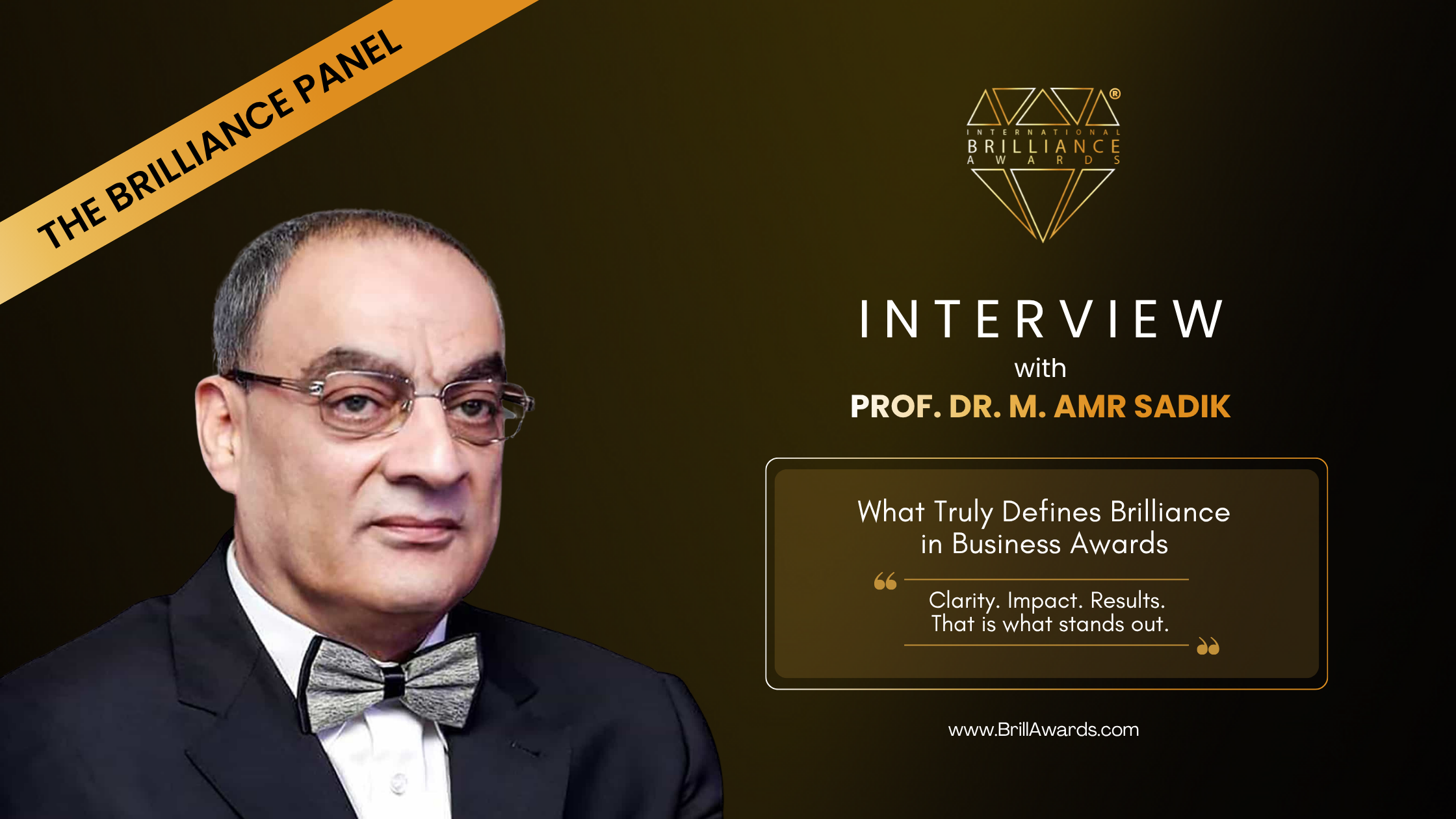
Insights from Prof. Dr. M. Amr Sadik | International Brilliance Awards
What Truly Defines Brilliance in Business Awards
The Brilliance Panel is a new series from the International Brilliance Awards™, where we speak directly with our judges to understand what truly stands out.
In this edition of The Brilliance Panel, Prof. Dr. M. Amr Sadik, Group Chief Human Resources Officer at CDIC “Katakit”, shares his perspective, shaped by over 30 years of HR leadership across international organisations in the Middle East and beyond.
From developing talent frameworks to aligning HR strategy with business priorities, Prof. Sadik brings a clear, structured approach to leadership and organisational effectiveness. In this interview, he shares what he will be looking for when reviewing entries, the common mistakes organisations make when presenting their work, and what truly defines strong, high-impact submissions.
With over 30 years of HR leadership across international markets, what core principle of people strategy has remained constant for you?
The core principle that has remained constant is that a people strategy must be value-driven, not activity-driven. Across three decades, what has changed significantly is how we manage people, but not why.
The purpose of HR has always been to enable organisations to execute strategy through people. What distinguishes leading organisations today is their ability to translate business priorities into clear talent actions — who to hire, what to build, where to invest, and when to transform.
Today, this has become more defined. HR must operate as a decision-maker in how human capability is built and deployed, not just as a support function.
You have a deep global perspective. How do you manage people differently across various cultures and parts of the world?
Global leadership requires a balance between cultural awareness and organisational consistency.
There are non-negotiables: ethics, performance standards, and accountability remain consistent across markets. At the same time, leadership style, communication, and engagement must adapt to local cultures.
Many organisations go too far in one direction. Either everything is standardised, or everything is localised. Strong organisations build a clear global structure while allowing flexibility where it matters.
What is the most important part of a winning talent strategy today?
The most critical element today is dynamic capability building. We are no longer operating in a simple hire–develop–retain model.
Organisations must continuously reskill, redeploy talent, and integrate human and digital capabilities.
Winning organisations treat talent as a dynamic portfolio rather than a static workforce. The real advantage lies in how quickly capability gaps are identified and addressed before they impact performance.
We are in a high-tech era. What is one “old” HR rule that you think is still perfect for today?
The timeless rule is: hire for attitude, train for skill.
In the current environment, technical skills have a much shorter lifecycle. What endures are learning agility, cognitive flexibility, emotional intelligence, and sound judgment.
Technology can support intelligence, but it cannot replace human intent, adaptability, and decision-making.
What is the key to driving lasting performance and culture change?
Sustainable change is driven by alignment, not isolated initiatives.
Culture changes when leadership behaviour, organisational systems, and employee experience are aligned. What leaders demonstrate, what gets measured and rewarded, and what employees experience daily must all support the same direction.
Many transformation efforts fail because they focus on communication rather than redesigning how the organisation actually operates.
As you prepare to review entries for the International Brilliance Awards™, what will you be looking for first?
I will be looking for strategic relevance and measurable impact.
Does the initiative solve a real business problem? Is there clear evidence of results, both quantitative and qualitative? Is the solution scalable and sustainable?
Brilliance is not about effort. It is about outcomes that matter.
What is the first thing you look for when you open a submission?
The first thing I look for is clarity of the problem statement.
A well-defined problem shows that the organisation understands what needed to change, why it mattered, and what was at stake. Without that clarity, even strong execution lacks credibility.
In your experience, what is the most common mistake people make when presenting their success stories?
The most common mistake is confusing activity with impact.
Many submissions describe programmes launched, training delivered, or systems implemented, but do not clearly show what changed.
Strong submissions focus on the before-and-after impact; what value was created and what difference the initiative made to the business.
What does “brilliance” mean to you?
Brilliance is the ability to translate insight into sustained, scalable impact.
It is not about complexity, sophistication, or even innovation alone. True brilliance lies in solving the right problem, executing with discipline, and delivering measurable and lasting value.
Often, the most brilliant solutions are not the most complex, but the most precisely designed and consistently executed.
About the International Brilliance Awards™
The International Brilliance Awards™ are a global business awards programme recognising organisations, teams, and individuals who deliver real, measurable impact. Established in 2014, the awards bring together entries from across industries and countries, all reviewed through an independent judging process focused on strategy, execution, innovation, and results.
For those preparing to enter, understanding how submissions are evaluated, and what judges look for, can make a real difference.


