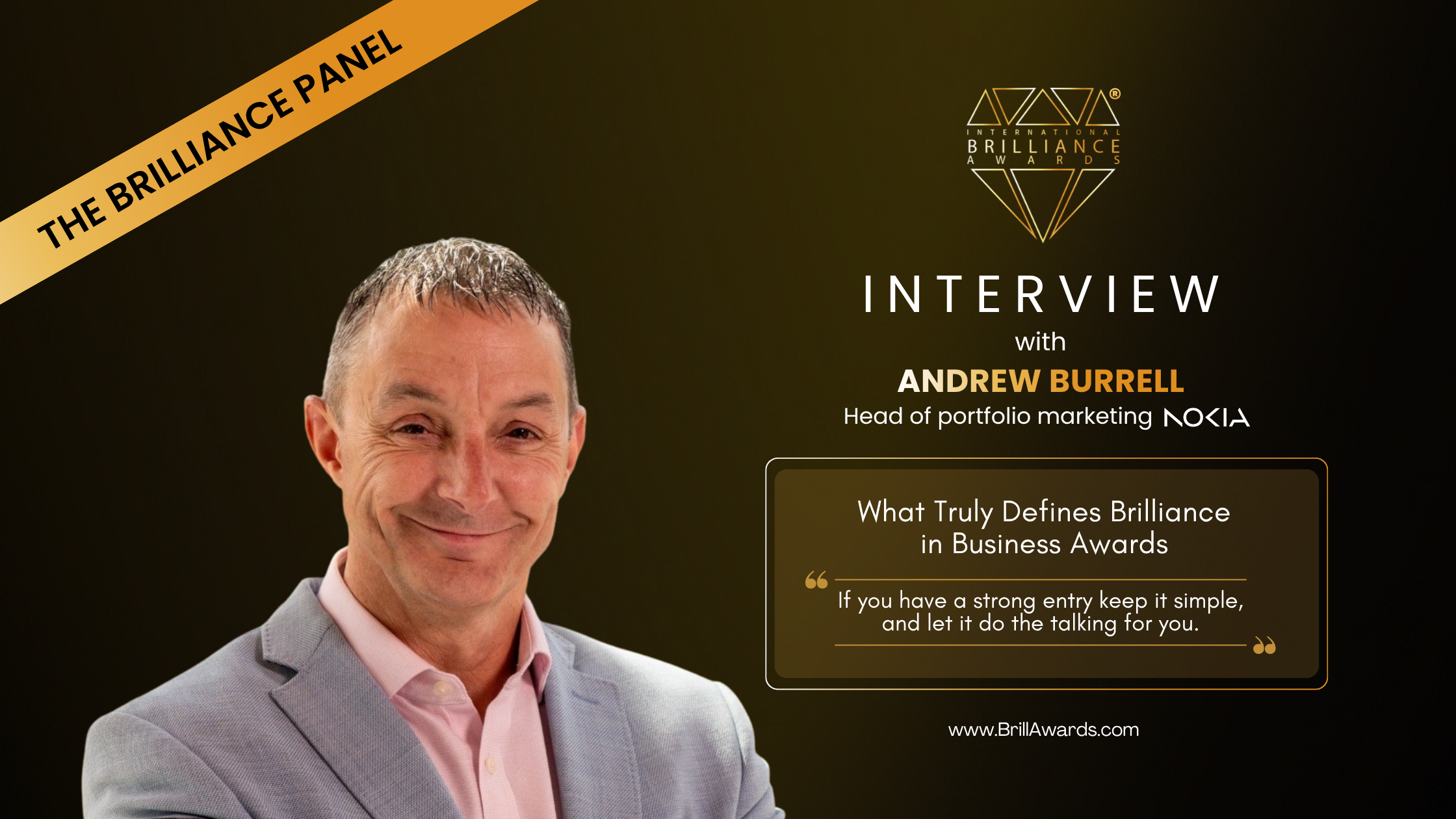
The Brilliance Panel: Insights from Andrew Burrell, Head of Portfolio Marketing, Nokia
What Truly Defines Brilliance in Business Awards
The Brilliance Panel is a new series from the International Brilliance Awards™, where we speak directly with our judges to understand what truly stands out.
In this edition of The Brilliance Panel, Andrew Burrell, Head of Portfolio Marketing at Nokia, shares his perspective. His insights are shaped by a distinguished career driving global marketing strategies and commercial performance within high-scale B2B environments.
From orchestrating portfolio marketing at Nokia to serving as a key judge for the Sales & Revenue Brilliance Awards, Andrew brings a data-driven and results-oriented approach to brand growth. In this interview, he shares what he will be looking for when reviewing entries, the importance of aligning marketing with revenue generation, and what truly defines high-impact submissions in today’s competitive landscape.
Your career spans many roles in the telecoms sector. How has this diversity of experience shaped your view of portfolio marketing?
Marketing is a unique discipline, but understanding the business and knowing what customers are thinking is essential. The very best product marketers go beyond that, with deep insights into competition, market trends, commercials and the product itself. Marketers are very passionate about their careers, but spending time outside of marketing almost always pays off in the long run. Sales is normally seen as the natural steppingstone, but operations, product management and other roles bring wisdom and help you relate to peers as your career progresses.
What do you think are the biggest “human realities” holding back the adoption of AI?
What I meant by “human realities” is that when it comes to change, technology is only ever a small piece of the puzzle. If you want your marketing team to fully adopt and embrace AI, you need to stop worrying about which tool or AI model is best. My experience shows that people and process are always far more critical to success. To effect change you need an AI strategy that is both top-down and bottom-up. Without your team’s buy-in, advocacy, and operational knowledge your AI initiatives are destined to fall short. AI can easily improve productivity, but those gains will be limited to individual tasks or sub-tasks unless you look at the bigger picture. Process thinking is not always a natural marketing mindset, but if you don’t have it find someone in your organisation that does – or bring in an outside consultant if needed.
You believe in the power of storytelling. How do you use narrative to make complex cloud and network technologies accessible?
Storytelling and narrative sound like classic “marketing-speak”, but when done right they have real power. Cloud technologies and B2B decision-making are complex: there is always a risk that your products and marketing reflect that complexity.
In Nokia we have used “Sense.Think.Act.” as a storytelling framework to explain our technology. This is intuitive because it mirrors the way in which nature works. One of the coolest things we did was to recreate a Finnish forest at a trade show, complete with bird song, fake campfires and the scent of pine needles. It was completely different to what our competitors were doing and very memorable for our customers. You can see some photos here.
How do you encourage teams to experiment and take calculated risks?
Psychological safety. It’s a phrase that is used a lot, but creating a culture where people feel empowered and trusted is key to creativity and innovation. Your team needs to know that you have their back. People love to talk about success but are normally scared to talk openly about failure. I try to channel my inner Ted Lasso and be curious: Why do you think this went wrong? What did you learn from it? How could we do it differently next time? We live in a world with incredible uncertainty and ambiguity – doing something, even if it turns out to be wrong helps reveal the right path.
What is the most exciting technology trend you are currently watching?
Many years ago, I predicted that the “Internet of Dogs” would be a big deal. Apart from a few pet trackers that hasn’t really happened although I remain hopeful!
It may seem strange to some, but I still see SaaS as really transformational. Companies love Software as a Service because of the ability to scale new business and investors love the promise of ARR (Annually Recurring Revenue). But there is another part of this picture that is sometimes neglected – that SaaS lets you put the product in the hands of your customer almost instantly. No friction, no delays – just let them try it and see if it delivers on the promise. That’s transformational, not just for product development, but also for marketing.
What, in your view, will separate a strong entry from one that doesn’t quite stand out?
What usually separates the best entries is the ability to show real business impact. Not clicks, eyeballs or activity metrics but cost savings or revenue growth.
What is one thing entrants often overlook when preparing their submissions?
That sometimes less is more. By that I mean picking a handful of key metrics, instead of over-loading your entry with a dozen different datapoints. Likewise, if you have a strong entry keep it simple, and let it do the talking for you: shoehorning in lots of buzzwords can distract or dilute the power of the entry itself.
What does “brilliance” mean to you?
I think brilliance is something that you know when you see it, but defining it is a little harder! I’d say that it is something different that you haven’t seen before. Something that catches your attention and makes you think. Something that might look a bit odd at first, but after reflection makes perfect sense.
About the International Brilliance Awards™
Founded in 2014, the International Brilliance Awards™ recognise work defined by clear thinking, strong execution, and meaningful business impact across organisations worldwide.
The International Brilliance Awards™ serve as the flagship programme of the Brilliance Awards family, which includes Business Brilliance Awards, HR Brilliance Awards, Internal Communications (IC) Brilliance Awards, Marketing & PR Brilliance Awards, Sales & Revenue Brilliance Awards, and Sustainability & ESG Brilliance Awards.
Each programme focuses on a distinct area of organisational performance, while maintaining a consistent standard of evaluation through an independent, blind judging process.