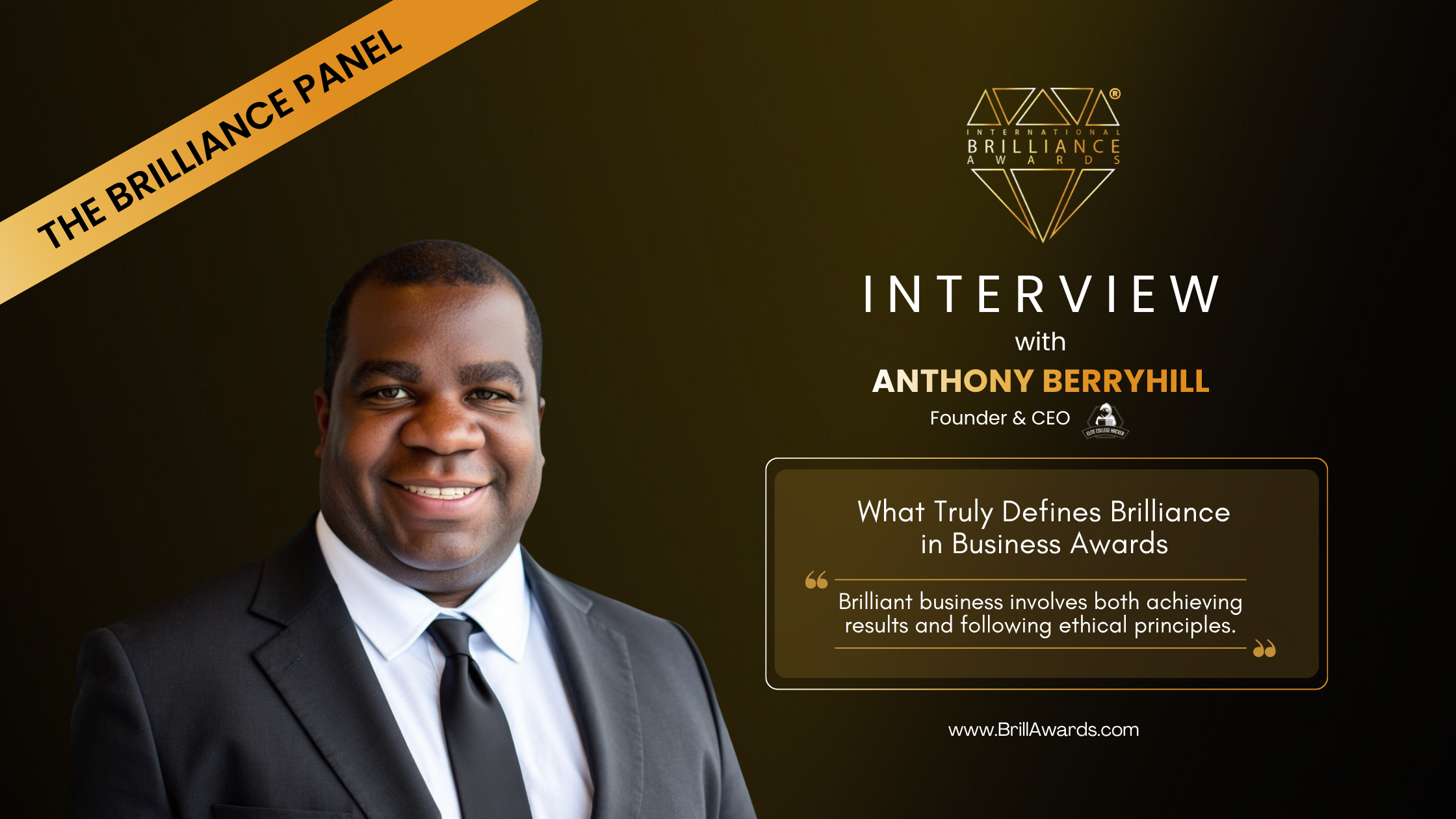
The Brilliance Panel: Insights from Anthony Berryhill, Founder & CEO, Elite College Hacker
What Truly Defines Brilliance in Business Awards
The Brilliance Panel is a series from the International Brilliance Awards™ where we speak directly with our judges to understand the “why” behind award-winning work. In this edition, we sit down with Anthony Berryhill, an education strategist and founder & CEO of Elite College Hacker and Berryhill Global Advisors LLC. A triple Fellow of the Royal Society of Arts, Geographical Society, and Asiatic Society, Anthony brings 25 years of experience in academic innovation and corporate learning across the US and UK. Specializing in social mobility, he has maintained a remarkable 100% college persistence rate, guiding first-generation students into elite institutions like Harvard, Stanford, and LSE.
Currently on the Harvard instructional staff and ranked as a top global educator by Thinkers360, Anthony’s career has been dedicated to driving verified, internationally validated impact in education access and community equity. In this interview, he sheds light on the “hidden curriculum” facing first-generation students, why traditional education benchmarks are failing social mobility, and the non-negotiable role of ethical leadership in modern business. He also reveals exactly how he cuts through corporate “babble” to evaluate genuine impact when reviewing award entries.
With 25 years of experience, what do you believe is the most critical factor in helping students from first-generation backgrounds succeed at elite global institutions?
There are two critical factors. The first is access to information and resources. Many students from first-generation backgrounds actually have the academic ability and personal qualities to succeed but due to their lack of wealth have no awareness of the opportunities they qualify for. In my case, the only reason I knew about Stanford was because I had access to debate, and learned about the tournament. The second factor is lack of training. Many FGLI students attend may earn top marks but are in schools that are at or behind grade level. This causes many students, especially ones from large charter schools or urban public schools, to fail to persist since they are not informed about best practices or the expectations of academic rigour. One of the main areas of focus in my work is to make the implicit explicit, to unravel the “hidden curriculum” of elite global institutions by making information transparent and accessible. In many cases, mission critical norms and advice are never spoken—elite institutions assume that everyone—have rich families to tell them how things actually work.
You were recently recognised as a 2026 Thought Leader of the Year. In your view, what is the most significant shift currently happening in the intersection of education and social mobility?
The most significant shift is that there is a global-wide public recognition of the intolerability of the status quo. In other words, as the global labor marketplace evolves, especially in the U.S., which is especially impossible to navigate, regardless of one’s qualifications—it is no longer acceptable or safe to assume that a college experience equals employability. And if you can’t get a job after 4 years of college, that also means that education is failing to support social mobility either.
This was an experience I had at Stanford (BA) and at Yale (PhD). Although these are top schools, the level of hands-on support or intelligence sharing re: social mobility and employment is extremely sparse. It is assumed that one already has social mobility. This is an education space wide problem. Most current approaches to curriculum development and teaching operate from a “rank ordering” philosophy where one’s ability to perform on an assessment is assumed to be measures of qualification nor unearned traits (i.e., the socioeconomic status of one’s family). Errors in people development such as poor teaching, misaligned curricula, hostile classroom practices, identity bias, etc., have been let off the hook for decades under the assumption that “education works.” It hasn’t. AI and such are in my view a positive revelation: they reveal and open cracks in educational systems that have been failing nearly everyone for a century. There is an opportunity to take a hard sober look at workplace L&D, school education, the workforce pipeline, etc. and to make real—not symbolic—changes to ensure both social mobility but also, equal opportunity for all.
As a Harvard instructional staff member, how do you ensure that leadership development remains impactful and “human” in an increasingly digital and automated landscape?
The core elements of leadership development exist whether or not one is virtual. Regardless of the technical form leadership in my view is about helping/facilitating one self (and others) achieve a particular goal. There is a foolish but popular assumption that AI and social media have denied people the opportunity to learn social skills. In my opinion, that is just social programming to hide preexisting problems in leadership philosophies/practices to defend noninclusive cultures.
Specifically, the key competencies to maintain and support human engagement and group leadership are the same regardless of form. Empathy, reflective listening, egolessness, perspective taking, etc. are skills that require someone to have a strong genuine interest in others and their well-being. That can – and is felt – both online and in person. The failures in education during COVID were not because of Zoom. Students suffered because teachers often tripled the work loads without adjusting for student capacity or mental wellbeing. Schools in the U.S. (esp. many Ivy/Ivy+ universities) were often misleading/dishonest to push students back to campus without adequate care to ensure such expectations were reasonable. And most of all, the social environment of many U.S. schools was already toxic to most kids. Many of my students during the COVID time were female girls who told me that they were relieved that they could “attend my STEM classes in peace, not having to deal with sexist teachers or boys who told us to be quiet.”
In other words, the lack of humanity is not in the virtual dimension or COVID. It’s been present within failing, but popular, philosophies and practices re: leadership, and the poor ways in which students had already been treated in schools. These were problems that remained unspoken/ignored because the status quo has been comfortable. Recent changes, in my view, have exposed such systematic flaws and therefore, have helped many education advocates, and students, no longer feel alone in highlighting such problems.
What advice would you give to social entrepreneurs looking to scale their own impact independently?
I would tell them to scale according to their lifestyle first. There are many, many ways to do social entrepreneurship correctly. It’s easy not to recognise this because much of the public celebration of social impact work, at least in the States, only values a narrow set of backgrounds: either entirely cultural, or entirely organisational (with high marketing budgets), or entirely activist. Those focused in more results-oriented work tend to be ignored. As a result of that, entrepreneurs, like myself, make flawed assumptions about how they are supposed to work, and how they are supposed to scale.
In my case I knew none of the popular social entrepreneurship models worked since I’ve bootstrapped since I started. Taking my own approach has fit my situation and skill set well. For example, I don’t work well with TikTok. But in choosing an incremental scaling approach, I’ve been able to keep costs down relative to revenue and avoid failing due to lack of cash flow.
I could sum up this advice in a phrase: scale in the manner that fits you best. Ignore the outside noise.
What do you believe is the most essential quality a leader must possess to drive global equity today?
A leader must first and foremost love and value people. That may seem like a strange answer, but it is the most important. It is also rare. If a leader does not bother to think about people from other backgrounds, perspectives, and experiences, they by definition are not a leader—they are merely a cog in a machine. Leaders think about how to include and influence others, especially those who add new cultures, assumptions, skill sets, etc.
In global business this is not optional. Leaders lacking cultural intelligence pay the price when it comes to high stakes negotiations abroad. Leaders who do not value global equity make catastrophic HR and People decisions that increase legal risk, attrition risk, and key person risk.
And most of all leaders need to love and value people. There seems to be the opposite view in the labor market, esp. with high tech firms. Employees are treated as disposable. In adequate or no noticed is given to international graduates expecting visas. Companies announce explosive growth but then layoff tons of top performers. These actions are not leadership: they are short term actions that are currently destroying at least 2 generations of talent—an effect that will be extremely difficult to fix on the back end. When I evaluate brilliance and leadership, I look for leaders who are intentional and thoughtful – two traits that are essential for coming up with disruptive, highly profitable, and value adding enterprises.
Why is independent and blind judging important in awards?
Without independence and blind judging, awards are merely social popularity campaigns instead of external validation of good work. When awards are not independent, strong applicants are deterred because they don’t want to waste their time. This is a personal area for me – in Austin, TX most of the available tech/local awards are measures of community popularity, not results or impact. In universities too often top awards, i.e., awards for U.S. PhDs in teaching, are determined by politics, not student feedback or pedagogical excellence. As a result, such awards have little or no purchase outside of their respective small subcultures.
Blind and independent judging allows an award to have credibility with both people within a field but also stakeholders in other adjacent areas. I would not judge for a system with anything less!
What do you personally look for when reviewing an entry?
I look for 3 main things. First, clarity in expression and writing. Much of winning anything high stakes – from an award, to a college application acceptance, to a VP+ level role, is about the narrative you tell and your excellence in communication best practices when telling it. For me, entries that communicate complex ideas simply and with a minimum of corporate “babble” or “tech speak” are far more impressive than ones filled with inaccessible jargon and vague MBA vocabulary.
Second, I look for a clear articulation of impact. Impact does not need to echo the level of a Fortune 500 company. Even helping a small number of people, or piloting a program on a small level that can have global implications if deployed large-scale all counts as Best in Class level impact.
Third, regarding differentiation, I like when an entry directly states what makes them different, how they figured out that differentiation, and the processes they used to get to where they are. I love reading about the thought process, key areas of the origin story, and how that all motivated the strategic decisions of an entrant.
What does “brilliance” mean to you in business?
For me, brilliance in business means being able to achieve results through acting on best practices. It is not brilliant to have a 10% increase in stock and layoff people the next day. It is not brilliant to hire a homogeneous senior leadership staff and brag about net revenue. Those kinds of companies are toxic.
Brilliant business involves both achieving results and following ethical rules/principles when doing so. It is easy to behave poorly in business for profit. It is hard to make profit while acting on best practices. I do everything I can as a judge to reward those businesses that serve as global role models for how to succeed in business while always doing the right thing—even when no one is looking.
About the International Brilliance Awards™
Founded in 2014, the International Brilliance Awards™ recognise work defined by clear thinking, strong execution, and meaningful business impact across organisations worldwide.
The International Brilliance Awards™ serve as the flagship programme of the Brilliance Awards family, which includes Business Brilliance Awards, HR Brilliance Awards, Internal Communications (IC) Brilliance Awards, Marketing & PR Brilliance Awards, Sales & Revenue Brilliance Awards, and Sustainability & ESG Brilliance Awards.
Each programme focuses on a distinct area of organisational performance, while maintaining a consistent standard of evaluation through an independent, blind judging process.